Date: January 2026
Status: Beta
The API Integration Governance Problem
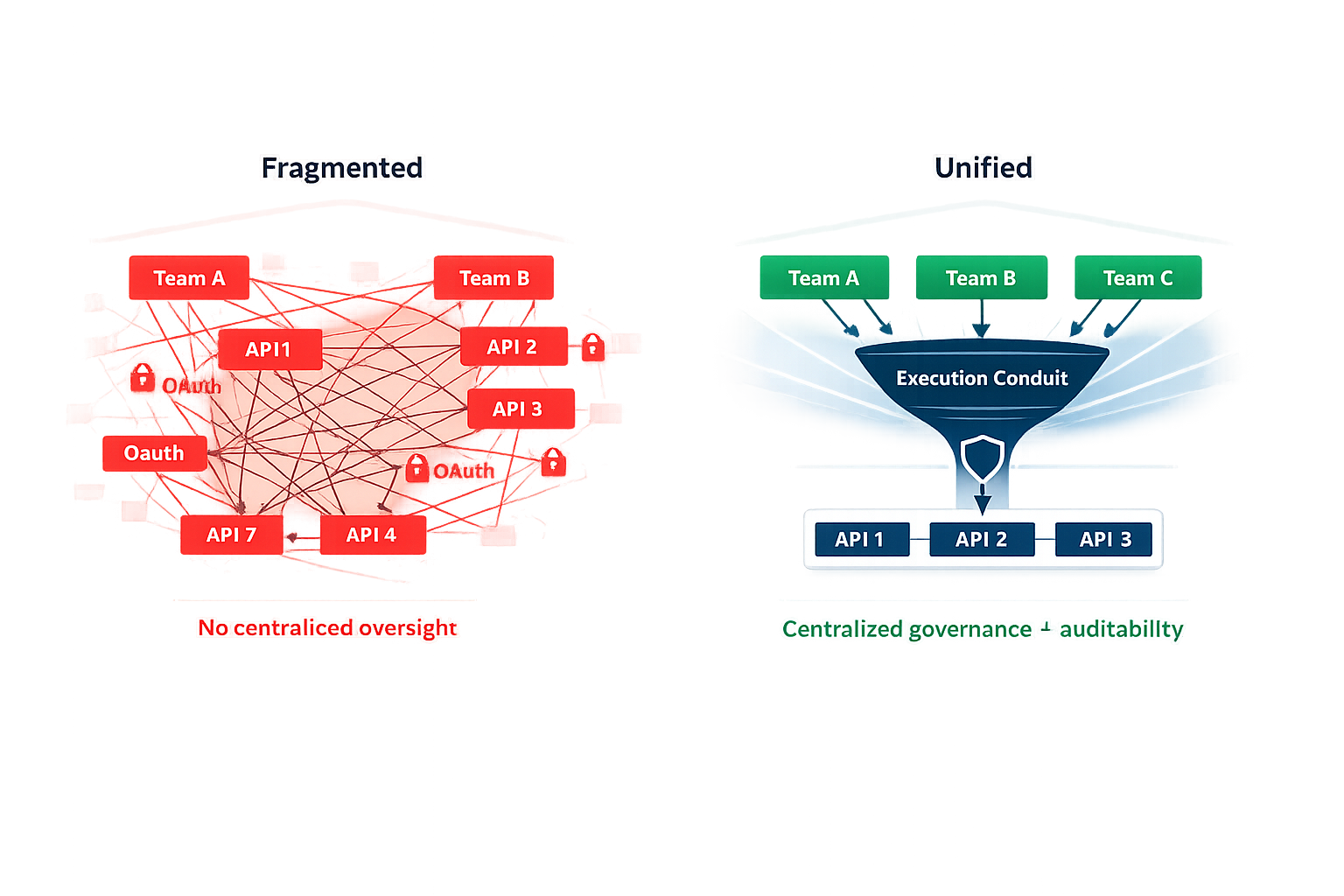
You wire up a webhook, handle OAuth for a single user, and write 50 lines of glue code. It works, until next week brings a GitHub-to-Jira sync requirement, then a Gmail-to-HubSpot flow. Suddenly, your codebase is a graveyard of unique implementations, each with its own quirks, version drift, and distributed credentials.
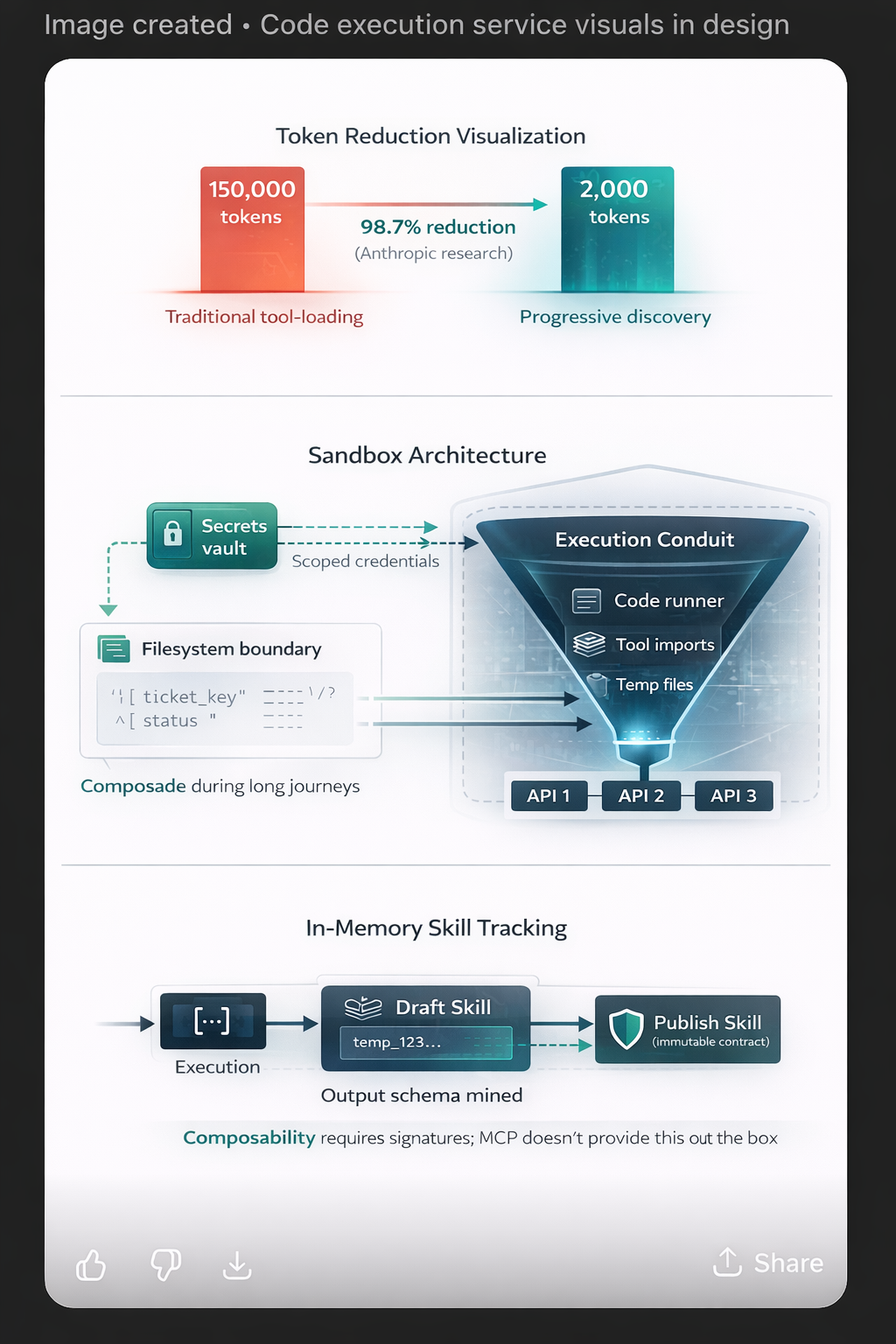
When AI agents enter the mix, the problem compounds. Traditional approaches either burn 150,000+ tokens on documentation just to initialize a session, or require manual tool definitions for every endpoint. Neither approach scales to the hundreds of tools modern teams require.
What Anthropic Proved (And How We Build On It)
The Problem: Context Bloat
Traditional Model Context Protocol (MCP) implementations load all tool definitions upfront. Before the agent even reads your request, 98% of the context window is burned. Furthermore, intermediate results often flow through the model repeatedly—fetching a transcript, processing it, and writing it back to a CRM results in the same data being loaded into context multiple times.
The Solution: Progressive Discovery + Code Execution
- Discover Servers: The agent searches for the relevant service (e.g.,
jira_cloud_api). - Discover Tools: It queries within that server for specific capabilities (e.g.,
create_issue). - Discover Usage: It fetches the exact JSON schema for the chosen tool.
Skills as First-Class Citizens: Solving the Composability Problem
In-Memory Skill Tracking
yamloutputs:
  key: string          # Jira ticket key
  id: string           # Ticket ID
  status: string       # Current status
This schema is immediately available for subsequent steps in workflow construction. The agent can reference previous executions via in-memory IDs, wiring outputs to inputs with full type validation.
The Paradigm Shift: Who Builds the Workflow?
| Traditional Approach | Agency as a Service |
|---|---|
| Engineer designs the workflow | Agent designs the architecture |
| Engineer places AI nodes | Agent decides where reasoning is needed |
| Focus: Implementation details | Focus: Business outcomes |
In our model, the agent is the architect; the engineer is the foreman. You manage the business concerns ("the why"), and the agent manages the technical implementation ("the how"). This separation allows for rapid prototyping and deployment of complex processes that would traditionally take weeks of manual development.
Security: Autonomy Within Boundaries
- Failure Isolation: Errors are contained within the sandbox, preventing catastrophic system failures.
- Autonomous Recovery: Agents see structured error messages and can self-correct their requests in real-time.
- Iterative Hardening: Security ratchets tighter over time based on empirical usage data rather than theoretical restrictions.
For the enterprise, this means centralized governance. You can create dedicated user IDs for agents with scoped permissions—read-only for research, write-only for triage—and maintain a comprehensive audit log of every API interaction.
Known Challenges (Beta)
Even with a strong architecture, there are practical challenges we’ve learned to name explicitly:
-
Maintaining the agent perspective (tool hierarchy confusion): Agents sometimes confuse top-level MCP tools (discovery, orchestration) with API tools callable inside code execution. The failure mode looks like trying to invoke MCP system tools from within the sandboxed runtime. This is a common “mental model” mismatch as agents scale—especially in long, multi-step workflow builds.
-
Token and credential lifecycle complexity: OAuth isn’t just “get a token once.” In production you have expiry, refresh, rotation, revocation, and provider-specific quirks. A core value of the hosted platform is taking on that lifecycle burden—centralizing credential storage, refresh behavior, and scoping—so engineers and agents can focus on outcomes instead of hand-rolled token plumbing.
Conclusion: From Integrations to Agency
The industry is moving past the era of fragmented, ad-hoc integrations toward unified agent orchestration platforms. By building on Anthropic's proven efficiency pattern and extending it with first-class composability, we are enabling organizations to deploy autonomous agents that deliver actual business value.