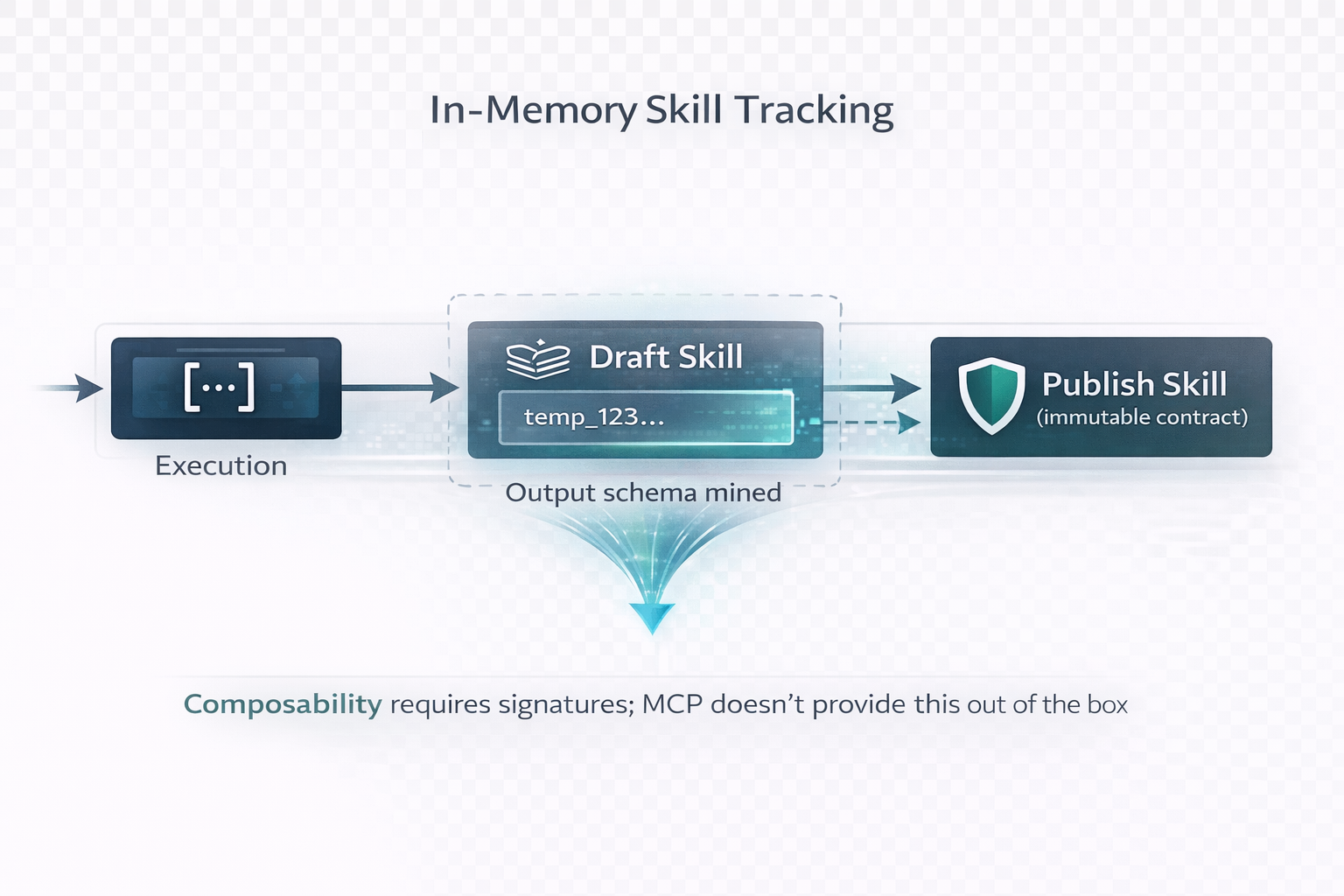
The "In-Memory" Capture: Never Lose a Breakthrough
This is a fundamental shift in the agent's journey. Instead of the agent "guessing" how to do something again later in a long workflow creation process, it has a trail of proven, testable blocks. The agent can reference previous executions via unique IDs, effectively "learning" your environment as it builds.
The Secret Sauce: Output Parameter Mining
When a skill draft is captured, the platform analyzes the return values in the sandbox and generates a typed schema:
yaml# Automatically mined from execution
outputs:
  ticket_key: string
  assignee_id: string
  status: string
Because these signatures are formalized, agents can wire outputs to inputs with 100% reliability. This is what allows an agent to build a complex workflow autonomously—it's not guessing; it's following a verified data contract.
The Skills Lifecycle: Draft to Production
Transforming a conversation into a production system follows a clean three-step path:
- Draft (Auto-capture): Every code execution is saved in-memory. The agent uses these to "scaffold" the workflow.
- Publish (Persistence): Once a logic sequence is proven, the agent (or user) promotes it to a Published Skill. This stores the code immutably and formalizes the input/output contract.
- Schedule (Automation): Published skills can be scheduled via cron or triggered via webhooks. This is where "agentic work" becomes "autonomous service."
Agent-as-Architect, User-as-Foreman
This architecture flips the traditional automation model. In tools like Zapier or N8N, the user is the builder, dragging boxes and wiring lines.